

LifeSync — Adaptive Routine & Habit Intelligence
LifeSync — Adaptive Routine & Habit Intelligence
LifeSync — Adaptive Routine & Habit Intelligence
Turns real-life signals into a realistic plan and keeps you moving with one clear Next Block
LifeSync is a recovery-first routine system designed for real days. It reduces cognitive load with progressive disclosure, clarifies what to do next, and helps users regain momentum through gentle replanning and reflection.
Detailed Case Study
Problem Statement
AI is Available for MacOS
AI is Available for MacOS
LifeSync — Planning That Doesn’t Collapse
LifeSync — Planning That Doesn’t Collapse
LifeSync — Planning That Doesn’t Collapse
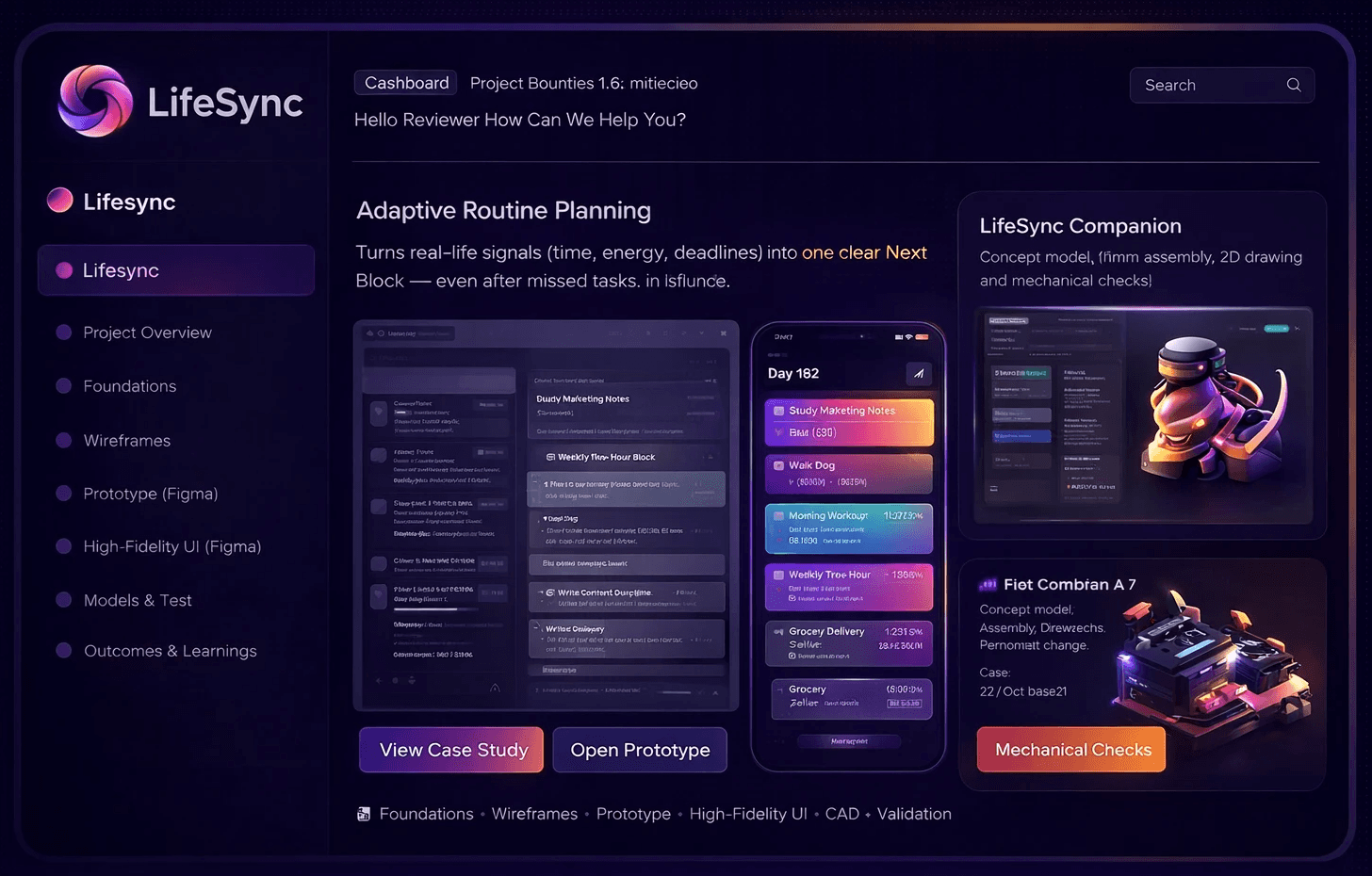
Most planners work on ideal days. LifeSync is built for real life—turning time, energy, and deadlines into a realistic plan and keeping users moving with one clear Next Block, even after missed tasks.
Most planners work on ideal days. LifeSync is built for real life—turning time, energy, and deadlines into a realistic plan and keeping users moving with one clear Next Block, even after missed tasks.
Most planners work on ideal days. LifeSync is built for real life—turning time, energy, and deadlines into a realistic plan and keeping users moving with one clear Next Block, even after missed tasks.
Foundations → Flows
Research synthesis, information architecture, and recovery-first user flows designed to reduce cognitive load and prevent drop-off
Foundations → Flows
Research synthesis, information architecture, and recovery-first user flows designed to reduce cognitive load and prevent drop-off
Foundations → Flows
Research synthesis, information architecture, and recovery-first user flows designed to reduce cognitive load and prevent drop-off
Prototype → Validation
Wireframes to high-fidelity UI with usability checks, edge-case handling, and measurable success criteria (time-to-next-action, recovery rate).
Prototype → Validation
Wireframes to high-fidelity UI with usability checks, edge-case handling, and measurable success criteria (time-to-next-action, recovery rate).
Prototype → Validation
Wireframes to high-fidelity UI with usability checks, edge-case handling, and measurable success criteria (time-to-next-action, recovery rate).
Solutions
Solutions
Solutions
How LifeSync Prevents Drop-Off
How LifeSync Prevents Drop-Off
How LifeSync Prevents Drop-Off
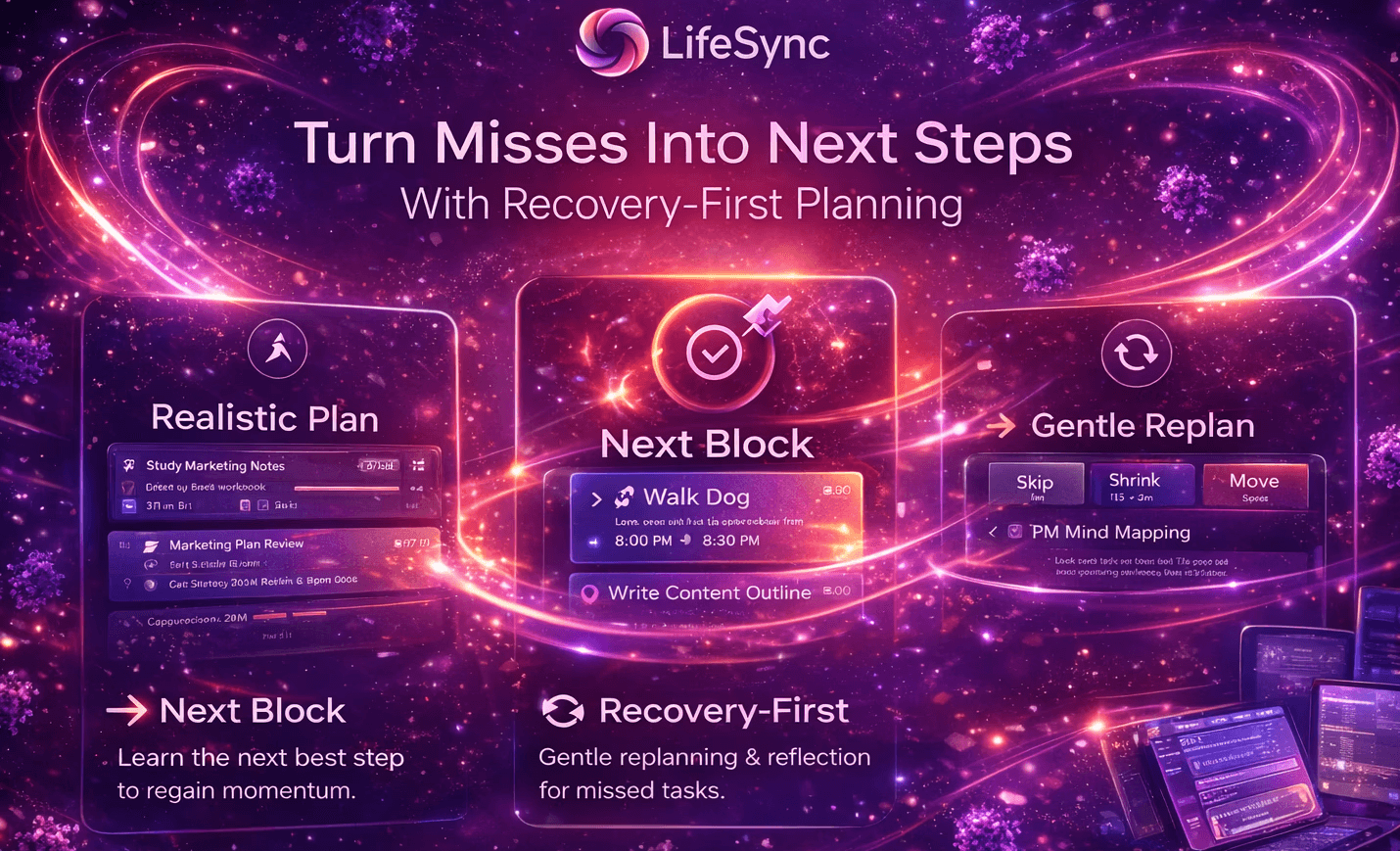
LifeSync is designed around one belief: consistency comes from recovery, not perfection. Every screen reduces cognitive load and guides users to a single best next step.
LifeSync is designed around one belief: consistency comes from recovery, not perfection. Every screen reduces cognitive load and guides users to a single best next step.
LifeSync is designed around one belief: consistency comes from recovery, not perfection. Every screen reduces cognitive load and guides users to a single best next step.
Signals → Realistic Plan
LifeSync captures lightweight signals (time available, energy, deadlines, commitments) and generates a minimum viable day—a plan that’s achievable even when the day derails.
Signals → Realistic Plan
LifeSync captures lightweight signals (time available, energy, deadlines, commitments) and generates a minimum viable day—a plan that’s achievable even when the day derails.
Signals → Realistic Plan
LifeSync captures lightweight signals (time available, energy, deadlines, commitments) and generates a minimum viable day—a plan that’s achievable even when the day derails.
One Clear Next Block
Instead of overwhelming lists, LifeSync surfaces one recommended next action with just enough context. Users start fast, stay focused, and avoid decision fatigue.
One Clear Next Block
Instead of overwhelming lists, LifeSync surfaces one recommended next action with just enough context. Users start fast, stay focused, and avoid decision fatigue.
One Clear Next Block
Instead of overwhelming lists, LifeSync surfaces one recommended next action with just enough context. Users start fast, stay focused, and avoid decision fatigue.
Build & Validate
Build & Validate
Build & Validate
From UX Decisions to Buildable Product
From UX Decisions to Buildable Product
From UX Decisions to Buildable Product
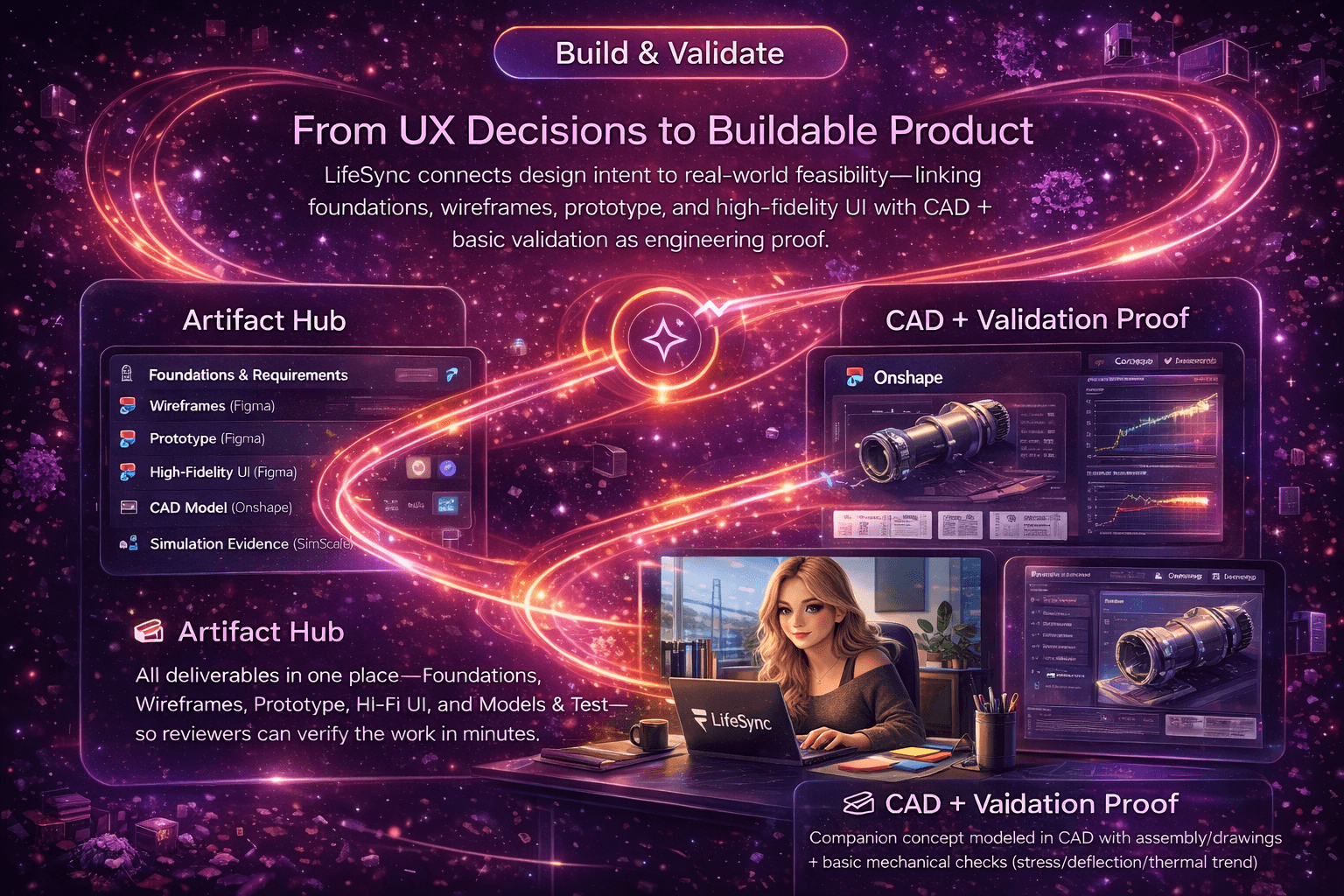
LifeSync connects design intent to real-world feasibility—linking foundations, wireframes, prototype, and high-fidelity UI with CAD + basic validation as engineering proof.
LifeSync connects design intent to real-world feasibility—linking foundations, wireframes, prototype, and high-fidelity UI with CAD + basic validation as engineering proof.
LifeSync connects design intent to real-world feasibility—linking foundations, wireframes, prototype, and high-fidelity UI with CAD + basic validation as engineering proof.
Artifact Hub
All deliverables in one place—Foundations, Wireframes, Prototype, Hi-Fi UI, and Models & Test—so reviewers can verify the work in minutes.
Artifact Hub
All deliverables in one place—Foundations, Wireframes, Prototype, Hi-Fi UI, and Models & Test—so reviewers can verify the work in minutes.
Artifact Hub
All deliverables in one place—Foundations, Wireframes, Prototype, Hi-Fi UI, and Models & Test—so reviewers can verify the work in minutes.
CAD + Validation Proof
Companion concept modeled in CAD with assembly/drawings + basic mechanical checks (stress/deflection/thermal trend) to support feasibility and iteration decisions.
CAD + Validation Proof
Companion concept modeled in CAD with assembly/drawings + basic mechanical checks (stress/deflection/thermal trend) to support feasibility and iteration decisions.
CAD + Validation Proof
Companion concept modeled in CAD with assembly/drawings + basic mechanical checks (stress/deflection/thermal trend) to support feasibility and iteration decisions.
Foundations
Prototype
Models & Test
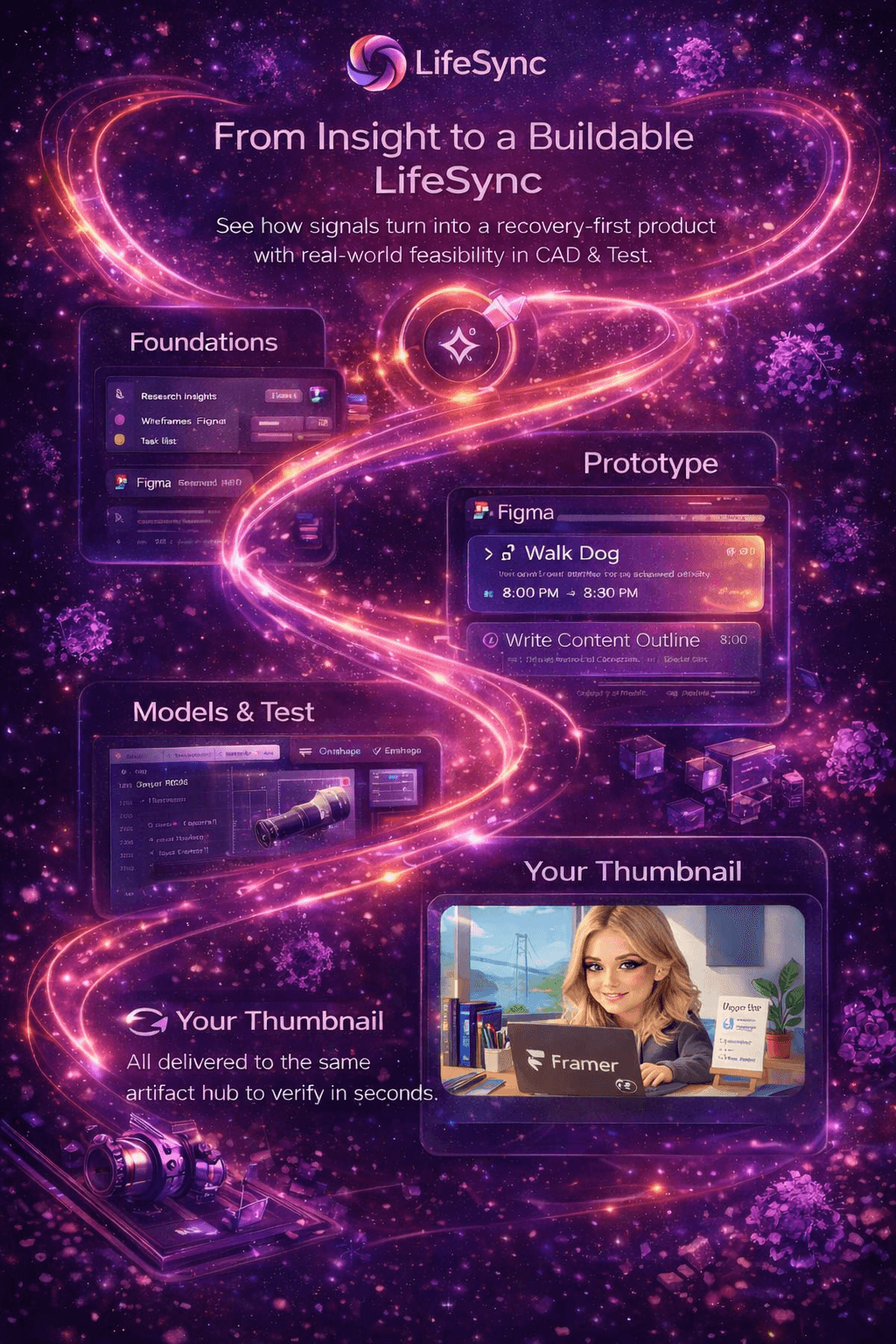
From Insight to a Buildable LifeSync
LifeSync isn’t just UI screens. It’s a recovery-first system built for real days—turning signals (time, energy, deadlines) into a realistic plan, surfacing one clear Next Block, and gently replanning after misses. This case study links foundations → wireframes → prototype → high-fidelity UI, plus CAD + basic validation to prove feasibility
Foundations
Prototype
Models & Test
From Insight to a Buildable LifeSync
LifeSync isn’t just UI screens. It’s a recovery-first system built for real days—turning signals (time, energy, deadlines) into a realistic plan, surfacing one clear Next Block, and gently replanning after misses. This case study links foundations → wireframes → prototype → high-fidelity UI, plus CAD + basic validation to prove feasibility
Foundations
Prototype
Models & Test
From Insight to a Buildable LifeSync
LifeSync isn’t just UI screens. It’s a recovery-first system built for real days—turning signals (time, energy, deadlines) into a realistic plan, surfacing one clear Next Block, and gently replanning after misses. This case study links foundations → wireframes → prototype → high-fidelity UI, plus CAD + basic validation to prove feasibility
Foundations
Designing for Real Days, Not Ideal Days
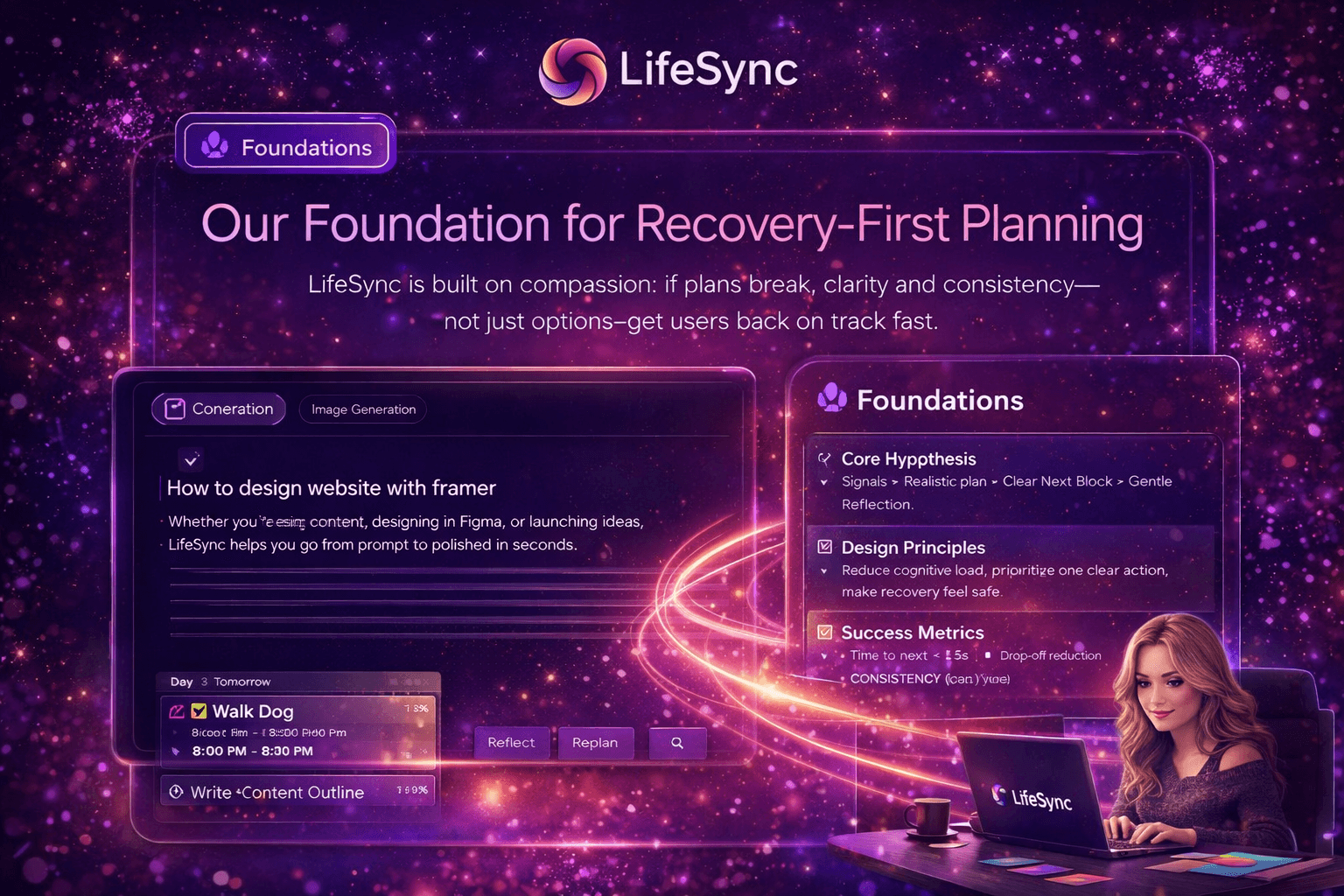
LifeSync is built on a recovery-first hypothesis: when plans break, users need clarity fast—not more options. These foundations guide every flow, screen, and decision.
Foundations
Designing for Real Days, Not Ideal Days
LifeSync is built on a recovery-first hypothesis: when plans break, users need clarity fast—not more options. These foundations guide every flow, screen, and decision.
Foundations
Designing for Real Days, Not Ideal Days
LifeSync is built on a recovery-first hypothesis: when plans break, users need clarity fast—not more options. These foundations guide every flow, screen, and decision.
Core Hypothesis
If we combine signals → realistic plan → one clear next step → gentle reflection, users will start faster, recover after misses, and stay consistent longer.
Design Principles
Reduce cognitive load, use progressive disclosure, prioritize one clear action, make recovery feel safe (no guilt), and keep choices constraint-aware.
Success Metrics
Time-to-next-action < 5s • Recovery completion rate • Drop-off reduction after misses • Fewer re-edits/decision loops • Consistency proxy (week-to-week use).
Core Hypothesis
If we combine signals → realistic plan → one clear next step → gentle reflection, users will start faster, recover after misses, and stay consistent longer.
Design Principles
Reduce cognitive load, use progressive disclosure, prioritize one clear action, make recovery feel safe (no guilt), and keep choices constraint-aware.
Success Metrics
Time-to-next-action < 5s • Recovery completion rate • Drop-off reduction after misses • Fewer re-edits/decision loops • Consistency proxy (week-to-week use).
Core Hypothesis
If we combine signals → realistic plan → one clear next step → gentle reflection, users will start faster, recover after misses, and stay consistent longer.
Design Principles
Reduce cognitive load, use progressive disclosure, prioritize one clear action, make recovery feel safe (no guilt), and keep choices constraint-aware.
Success Metrics
Time-to-next-action < 5s • Recovery completion rate • Drop-off reduction after misses • Fewer re-edits/decision loops • Consistency proxy (week-to-week use).
All-in-one
LifeSync Foundations — Built for Real Days
Designed around a simple insight: consistency comes from recovery, not perfection. These foundations guide the system—from information architecture and flows to prototype validation and edge-case handling.
All-in-one
LifeSync Foundations — Built for Real Days
Designed around a simple insight: consistency comes from recovery, not perfection. These foundations guide the system—from information architecture and flows to prototype validation and edge-case handling.
All-in-one
LifeSync Foundations — Built for Real Days
Designed around a simple insight: consistency comes from recovery, not perfection. These foundations guide the system—from information architecture and flows to prototype validation and edge-case handling.